My Child Is Afraid of the Dentist: 7 Gentle Ways to Help


At Bites Odontopediatría in Vitacura, every week we see children arrive afraid of the dentist and leave asking to come back. I'm Dra. Florencia Nogueira, pediatric dentist and clinical director of Bites, and this guide brings together the seven strategies that actually work.
Fear of the dentist is not a flaw in your child
Around 20% of children between ages 4 and 11 report fear of the dentist, according to the Journal of Dental Research. It's not a whim or a character problem: it's a normal, adaptive response to an unfamiliar environment full of smells, sounds, and strange objects near a very sensitive part of the body.
What we can control is how we prepare the child, how we talk about the visit, and what the clinical team does in the moment. This article walks through seven strategies that, combined, resolve dental fear in the vast majority of cases.
1. Start going to the dentist before it's needed
The first visit shouldn't be for pain or a cavity. Ideally it happens before the first birthday or when the first tooth comes in, as a preventive check where nothing is wrong and nothing needs fixing. That first experience (positive, brief, intervention-free) is the foundation of the child's entire future relationship with the dentist.
If your child is already past that age, it's not too late. What matters is that the next visit is a checkup, not an emergency.
2. Watch how you talk about the visit at home
Children read adults' tone with precision. If one parent fears the dentist (their own fear, inherited, or learned), the child absorbs it. Some concrete recommendations:
- Avoid loaded words: "shot", "hurt", "needle", "pulling teeth", "blood". Keep them out of your vocabulary in the days before.
- Never use the dentist as punishment or threat ("if you don't brush your teeth, I'll take you to the dentist"). Remember the dentist is your ally and wants to help with your child's teeth.
- Don't overcompensate: saying "nothing bad will happen to you" also plants fear. Better: "we're going so they can count your teeth", "the teeth-friend is going to show you her tools".
- If you're the one with dental fear, don't mention it in front of your child. You can work on it with your own dentist in parallel.
3. Use stories, books, and games at home
There are excellent children's books about visiting the dentist (search for "my first visit to the dentist"). Read them together in the days before. Play "dentist" at home: count a stuffed animal's teeth with a toy mirror, pretend to do a cleaning. This at-home rehearsal dramatically reduces anxiety at the real visit.
4. Choose a clinic designed for children
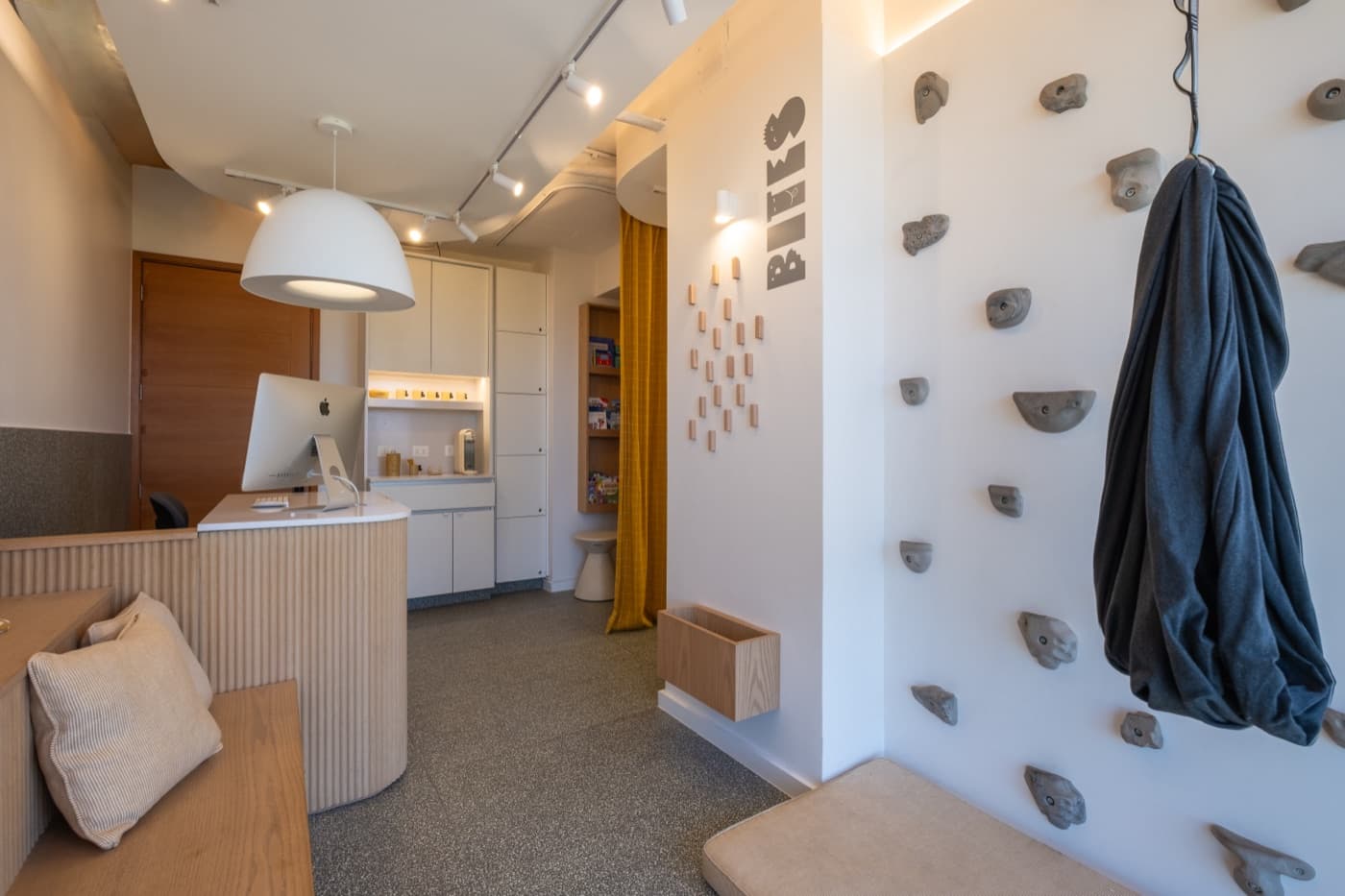
A generic dental office (hospital smell, exposed instruments, boring waiting room) raises anxiety before the child even sits in the chair. A clinic designed for children, from the space to the experience, does much of the work. At Bites, for example, we work with immersive decor, a climbing wall, a sensory swing, a reading corner, and ambient music, precisely so children associate the place with something interesting rather than something to fear.
5. Arrive without rushing
The hour before the appointment shapes the experience. A few suggestions:
- Book the first slot of the morning or after a nap. Never when the child is tired or hungry.
- Arrive 10 minutes early so they can explore the waiting room without pressure.
- Bring a comfort toy or stuffed animal if they ask for it.
- Don't promise rewards for "behaving": that plants the idea that there's something bad to endure. Better a genuine celebration afterward ("that went great, want to go play at the park?").
6. Know the clinical behavior-guidance techniques
Pediatric dentists trained in behavioral guidance use a set of evidence-based techniques:
- Tell-show-do: before each step, we explain what we'll do, show the instrument, then use it. Never surprises.
- Positive reinforcement: acknowledging the child's effort ("you're staying so still, that helps me so much").
- Progressive desensitization: if the child can't tolerate a step, we go back to the previous one and advance at their pace.
- Distraction: music, a ceiling TV, or simply a conversation about something the child cares about.
- Perceived control: giving the child a way to "stop" ("if you raise your hand, I stop").
These techniques aren't optional extras: they're part of the standard of care in modern pediatric dentistry. If the professional treating your child doesn't use them, that's a signal worth noting.
7. When anxiety is bigger: conscious sedation
Some children have severe anxiety, previous dental trauma, or special needs (autism, severe ADHD, certain syndromes) for whom behavioral techniques aren't enough. In those cases, conscious sedation with nitrous oxide is a very useful tool: the child stays awake and cooperative, but relaxed. It's safe, extensively studied, and reversible within minutes.
In more complex cases, full rehabilitation under general anesthesia may be indicated. Always as a last resort, with strict clinical criteria.
What to expect at a first visit to Bites
At Bites Odontopediatría (Av. Kennedy 7440, Office 920, Vitacura), the first visit is deliberately fun: touring the clinic with your child, meeting the doctors, counting teeth, getting familiar with the instruments. No treatment unless it's urgent. The goal is for your child to leave saying: "Mom, I want to come back."
If your child already fears the dentist or had a bad previous experience, mention it when you book. We can adapt the first appointment to focus on rebuilding trust before anything else.

Written by
Dra. Florencia NogueiraCo-founder · Pediatric Dentist · Clinical Director
Dr. Florencia Nogueira is a pediatric dentist and Clinical Director of Bites. A pioneer of laser pediatric dentistry in Chile, dedicated to creating positive experiences for the youngest patients, from infancy onwards.
Bites Odontopediatría · Vitacura, Santiago