My Child Hit a Tooth: Emergency Guide

What to do in the first 5 minutes
If your child has just hit a tooth, read this before anything else:
- Stay calm. Your child takes their emotional cue from you. Breathe.
- Control the bleeding with a clean gauze. 5–10 minutes of gentle pressure is usually enough.
- Identify what happened: a tooth fully out, broken, displaced, or loose?
- If fully out AND permanent: hold by the crown, rinse with milk, try to reimplant or store in cold milk. Critical window: 30–60 minutes.
- Call the pediatric dentist. For a baby tooth you have 24 hours; for an avulsed permanent tooth, the clock is already running.
Never: touch the root, rinse the tooth with tap water, reimplant a baby tooth, or wait to see if it heals on its own.
At Bites we handle dental-trauma emergencies. Contact us by WhatsApp or phone as soon as the accident happens.
Dental injuries in children are more common than you think
Dental trauma is one of the most frequent emergency visits in pediatric dentistry. According to the International Association of Dental Traumatology (IADT), up to one-third of children experience some form of dental trauma before age 14. Falls during a toddler's first steps, school accidents, and sports collisions are the most common causes.
When a child hits a tooth, parents understandably panic. There is blood, crying, and a lot of uncertainty. But knowing how to act in the first few minutes can make the difference between saving and losing a tooth. This guide will help you stay calm and make the right decisions.
Step by step: what to do after a dental injury
Step 1: Stay calm
It sounds obvious, but it matters. If you are calm, your child will settle down faster. Children regulate their emotions through the adults around them. Take a breath, assess the situation, and act with purpose.
Step 2: Control the bleeding
Apply gentle pressure with a clean gauze pad or damp cloth over the affected area. The mouth bleeds a lot due to its rich blood supply, so do not be alarmed if it looks like a large amount of blood. In most cases, bleeding stops within 5-10 minutes.
Step 3: Assess what happened to the tooth
Look carefully:
- Has the tooth shifted position?
- Did a piece break off?
- Did the tooth come out completely?
- Can your child close their mouth normally?
This information will be very helpful when you contact the pediatric dentist.
Step 4: Act according to the type of injury
Different injuries require different responses. Here are the most common scenarios.
If the tooth was knocked out completely (avulsion)
This is the most dramatic scenario, but also the one that benefits most from quick action.
If it is a permanent tooth
- Find the tooth. Always handle it by the crown (the white part), never by the root.
- Do not scrub it clean. If there is dirt, gently rinse it with milk or saline solution for a few seconds.
- Try to reimplant it. Place the tooth back in its original socket and ask the child to bite gently on a gauze pad to hold it in place. If the child is very young or uncooperative, do not force the reimplantation.
- If you cannot reimplant it, store the tooth in a container with cold milk, saline solution, or the child's own saliva. Do not store it in water or wrap it in paper.
- See a pediatric dentist within 30-60 minutes. Time is critical: the success rate of reimplantation drops sharply after the first hour.
If it is a baby tooth
Do not reimplant it. Reimplanting a baby tooth can damage the developing permanent tooth underneath. Control the bleeding, save the tooth (to confirm it came out in one piece), and consult a pediatric dentist within 24 hours.
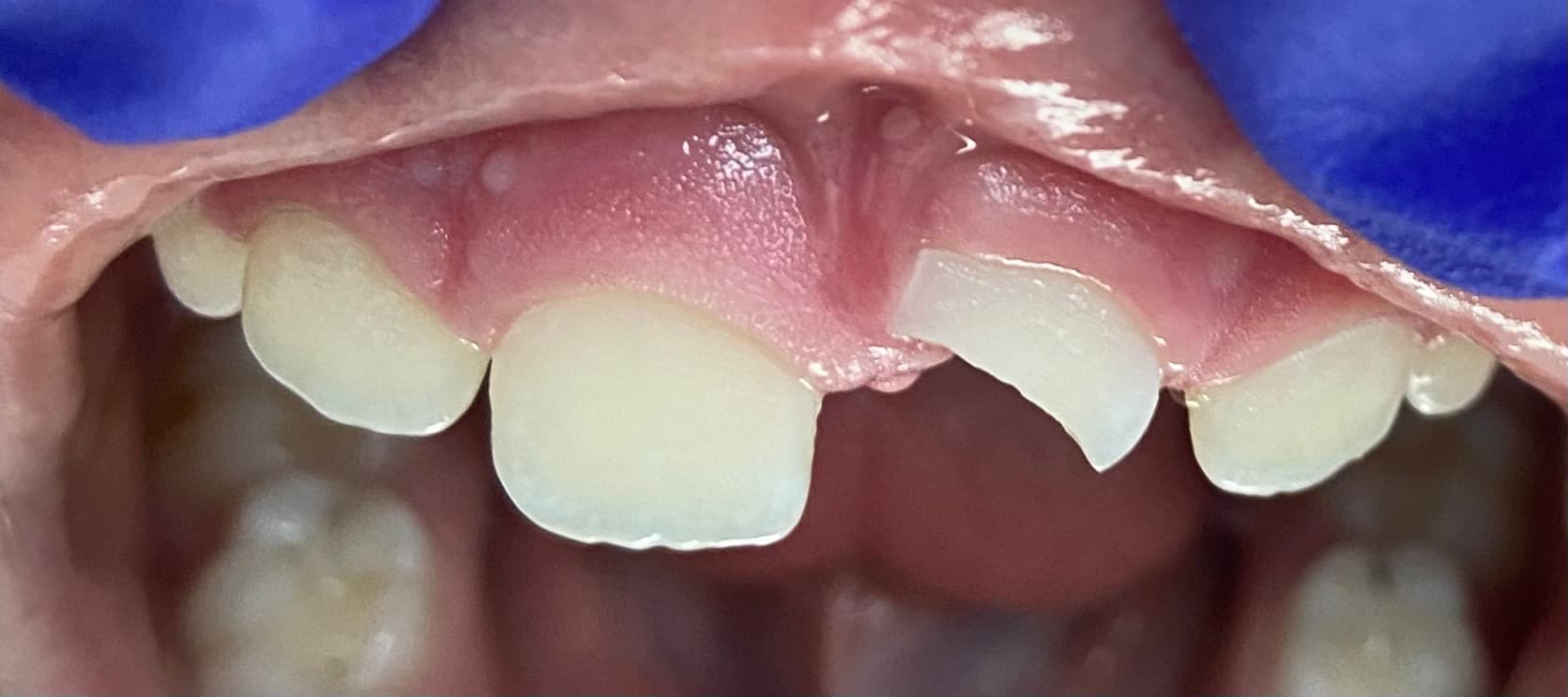
If the tooth broke (fracture)
- Find the fragment if possible. In some cases, it can be bonded back.
- Store the fragment in saline solution or milk.
- If the child feels pain from cold air or liquids, the fracture likely exposed the dentin or the pulp. Seek care as soon as possible.
- If you see a pink or red spot at the center of the broken tooth, the pulp (the "nerve") is exposed. This requires emergency attention.
If the tooth shifted or moved out of position
- If the tooth was pushed inward (intrusion), pulled outward (extrusion), or pushed sideways (lateral luxation), do not try to reposition it yourself.
- Apply cold on the outside of the cheek to reduce swelling.
- See a pediatric dentist within the first few hours. Treatment will depend on the type of displacement and whether it is a baby tooth or a permanent tooth.
If the tooth turns dark days later
After a blow, it is relatively common for a baby tooth to change color to gray, yellow, or pink in the weeks that follow. This indicates a change in the internal blood supply of the tooth. It does not always require immediate treatment, but it does need professional monitoring and follow-up X-rays.
Baby teeth vs. permanent teeth: why the distinction matters
The approach changes significantly depending on the type of tooth involved. Baby teeth have shorter roots and sit directly above the developing permanent tooth buds. A poorly managed trauma to a baby tooth can affect the formation, color, or position of the permanent tooth that will replace it.
This is why, even if the injury seems minor and the baby tooth "looks fine," a professional evaluation with an X-ray is always recommended to rule out damage that is not visible to the naked eye.
What NOT to do after a dental injury
- Do not touch the root of the tooth if it came out. The periodontal ligament cells on the root surface are what allow successful reimplantation.
- Do not store the tooth in tap water. Water damages root surface cells. Use milk, saline, or saliva.
- Do not wait and see. Dental trauma requires professional evaluation, even if the pain has subsided.
- Do not apply home remedies to the area (no rubbing alcohol, no hydrogen peroxide directly on an open wound).
- Do not reimplant a baby tooth. It can cause more harm than good.
When to go to the emergency room
Go to the emergency room immediately if:
- The child lost consciousness, even briefly.
- The child cannot open or close their mouth.
- There is a suspected bone fracture (visible deformity, intense pain when pressing on the jaw).
- Bleeding does not stop after 15-20 minutes of steady pressure.
- A permanent tooth was knocked out and needs urgent reimplantation.
In these cases, go to the nearest emergency department first, then coordinate follow-up with a pediatric dentist.
Prevention: reducing the risk of dental injuries
While not all accidents can be prevented, some measures help:
- Use a mouthguard during contact sports (soccer, basketball, martial arts, skating).
- Active supervision during the early years, especially at playgrounds and on stairs.
- Timely treatment of malocclusions: children with protruding upper teeth have a higher risk of dental trauma.
We are here to help in an emergency
At Bites Odontopediatría, we treat pediatric dental emergencies. If your child has suffered a blow to the mouth, contact us as soon as possible. The faster we act, the better the outcome. We are located in Vitacura, Santiago, and our team is ready to guide you from the very first moment.

Written by
Dra. Claudia ValenzuelaPediatric Dentistry
Pediatric Dentistry specialist dedicated to comprehensive care for children and their families. Specializes in preventive dentistry, nitrous oxide conscious sedation, complex rehabilitations, and laser frenectomies.
Bites Odontopediatría · Vitacura, Santiago