Frenectomy in Babies: When Is It Necessary?

What Is a Frenulum and When Does It Become a Problem?
Everyone has frenula in their mouth. These are bands of tissue that connect the tongue to the floor of the mouth (lingual frenulum) and the upper lip to the gum (labial frenulum). In most cases, they function without causing any issues.
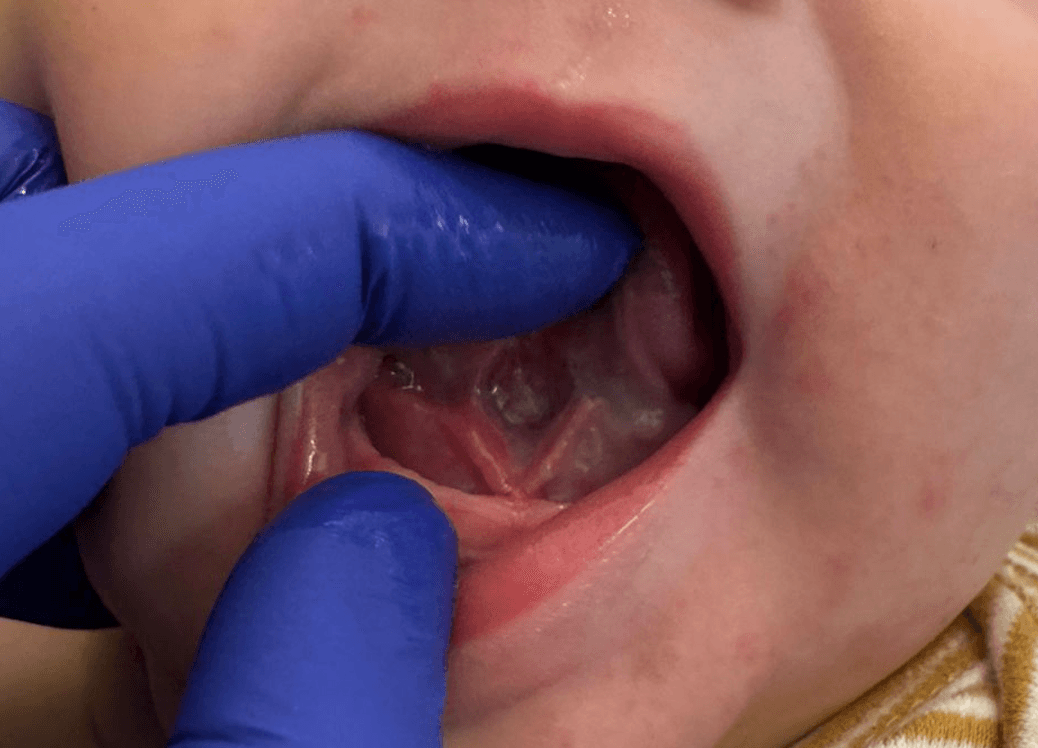
The problem arises when a frenulum is too short, thick, or rigid, restricting the movement of the tongue or lip. In medical terms, this is known as ankyloglossia (tongue tie) or labial frenulum restriction (lip tie).
An estimated 4% to 11% of newborns present some degree of ankyloglossia, according to data published in the International Journal of Pediatric Otorhinolaryngology. The actual prevalence may be higher, as many mild cases go undetected.
How to Tell if Your Baby Has a Tongue or Lip Tie
The signs are not always obvious to the naked eye. A restrictive frenulum can manifest in different ways, depending on its location and severity.
Signs in the Baby
- Difficulty latching onto the breast: the baby cannot achieve a good latch or frequently slips off during feeding.
- Clicking sounds while nursing: audible suction breaks indicating the seal between the mouth and breast is not adequate.
- Prolonged, exhausting feedings: sessions lasting more than 40 minutes repeatedly, with a baby who seems tired but still hungry.
- Poor weight gain: an inefficient latch can result in insufficient milk transfer.
- Frequent reflux or excessive colic: air intake from a poor seal can contribute to these symptoms.
- Heart-shaped tongue: when the baby cries or sticks out their tongue, a notch appears at the tip because the frenulum is pulling it down.
Signs in the Mother
- Pain while breastfeeding that does not improve with latch correction.
- Cracked, flattened, or lipstick-shaped nipples after feeding.
- Recurrent mastitis or blocked ducts.
- Low milk supply (a consequence of insufficient stimulation from a poor latch).
If you recognize several of these signs, it is worth seeking an evaluation. Not all breastfeeding problems are caused by a restrictive frenulum, but when that is the cause, identifying it early can save the breastfeeding relationship.
Diagnosis: Beyond Just Looking
Diagnosing a restrictive frenulum is not simply about checking whether a frenulum "looks" short. What matters is assessing function: how the tongue moves, what range it has, and how it affects feeding.
At Bites Odontopediatría, we perform a comprehensive functional assessment that includes:
- Frenulum observation: location, thickness, and point of insertion.
- Tongue range of motion evaluation: elevation, lateralization, and extension.
- Sucking assessment: how the baby sucks (at the breast or on a bottle).
- Coordination with other professionals: we work as a team with lactation consultants, speech therapists, and pediatricians to build a complete picture.
We use internationally recognized classification tools, such as the Hazelbaker Assessment Tool for Lingual Frenulum Function (ATLFF) and the Martinelli functional classification, which evaluate not only anatomy but actual movement capacity.
When Is Frenectomy Recommended?
Frenectomy is indicated when a restrictive frenulum is causing concrete functional difficulties. We do not operate on frenula simply because they "look short." The decision is always based on function.
The most common indications in babies are:
- Breastfeeding difficulties that do not respond to conservative management (latch correction, positioning, evaluation with a lactation consultant).
- Persistent maternal pain during breastfeeding.
- Failure to gain weight related to feeding difficulty.
In older children, a restrictive frenulum can cause:
- Speech difficulties (problems with sounds like "r," "l," "t," and "d").
- Orthodontic issues (diastema caused by a labial frenulum).
- Difficulty licking an ice cream cone, playing wind instruments, or clearing food debris with the tongue.
Laser Frenectomy: How the Procedure Works
At Bites, we perform frenectomies using a diode laser, which is the gold standard in pediatric dentistry for this procedure. The difference from traditional techniques (scissors or scalpel) is substantial.
Before the Procedure
- Complete functional evaluation.
- Discussion with parents about what to expect, including post-operative exercises.
- Coordination with the lactation consultant, if one is involved.
During the Procedure
- Duration: between 1 and 5 minutes of active work.
- Anesthesia: in babies under 3 to 4 months, the procedure is usually performed with topical anesthetic (gel) or without anesthesia, as the laser seals nerve endings and discomfort is minimal. For older babies, a small amount of local anesthetic may be used.
- Bleeding: minimal or none. The laser cauterizes vessels as it cuts.
- Stitches: not required.
After the Procedure
- The baby can breastfeed immediately afterward. In fact, we encourage it. The contact and sucking help calm the baby and allow them to begin using their tongue with its new range of motion.
- The treated area will appear white or yellowish for several days. This is normal. It is tissue in the process of healing, not an infection.
- Most babies are fussy for a few minutes and then return to their usual state.
Post-Operative Exercises: The Key to Success
This is a critical point. The frenectomy is only half the treatment. The stretching and mobility exercises performed afterward are equally important.
Why? Because the body naturally tries to close the wound and can produce scar tissue that restricts movement again. The exercises, performed several times a day for 3 to 4 weeks, help the area heal in an open, functional way.
During the appointment, we teach parents exactly how to do these exercises. They are simple, take less than a minute each time, and make a real difference in the outcome.
Is It Painful for the Baby?
This is the question that concerns parents most, and understandably so. The honest answer: the procedure itself causes brief discomfort. Babies typically cry more from being held still than from pain. Most calm down within minutes once they are nursing or taking a bottle.
The days following the procedure may require management with infant acetaminophen as directed, but overall the discomfort is mild and manageable.
A study published in Breastfeeding Medicine (2017) reported that 92% of mothers observed an improvement in breastfeeding within two weeks of their baby's laser frenectomy.
Teamwork: Why It Matters So Much
A frenectomy is not an isolated procedure. The best outcomes happen when a multidisciplinary team is involved:
- Lactation consultant: assesses and supports latch and milk transfer before and after the procedure.
- Speech therapist: works on orofacial function, especially in older children with speech difficulties.
- Pediatrician: monitors overall growth and development.
- Pediatric dentist: diagnoses, performs the procedure, and provides follow-up.
At Bites, we work within a network of these professionals to ensure every baby receives comprehensive care.
When to Seek Help
If your baby is struggling with breastfeeding, if nursing causes you persistent pain, or if you suspect something about your child's tongue or lip is not functioning as it should, schedule an evaluation. It will not always be a tongue tie, but if it is, acting early makes all the difference.
At Bites Odontopediatría in Vitacura, Santiago, we perform functional frenulum assessments and laser frenectomies. You can book an appointment through our website or via WhatsApp.

Written by
Dra. Florencia NogueiraCo-founder · Pediatric Dentist · Clinical Director
Dr. Florencia Nogueira is a pediatric dentist and Clinical Director of Bites. A pioneer of laser pediatric dentistry in Chile, dedicated to creating positive experiences for the youngest patients, from infancy onwards.
Bites Odontopediatría · Vitacura, Santiago